State of the art
An independent systematic review of 25 peer-reviewed studies (2014–2025) on drone detection at airports. Comparison of five technologies, fusion implementation strategies, key research gaps and where DroneEAR AI differs.
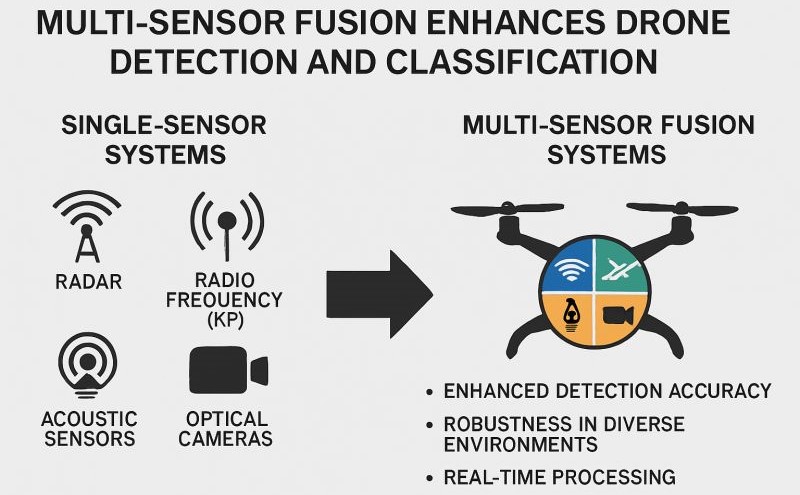
Commercial drones today pose a serious risk to airports, critical infrastructure and public events. Regulators (FAA, ANAC/DECEA) designate airport surroundings as no-fly zones, but the existence of rules is not enough — without real-time airspace monitoring capability, they cannot be enforced.
This page summarises the findings of an independent systematic review published in 2025 (Macedo, Caetano & da Costa, Elsevier), which analysed 25 peer-reviewed studies from 2014 to 2025. The goal is an accurate picture of the state of the art — not marketing.
Five detection technologies
Each technology has its own profile of advantages and limitations. None is universal — and that is precisely why fusion is the only path to reliable detection.
Acoustic detection
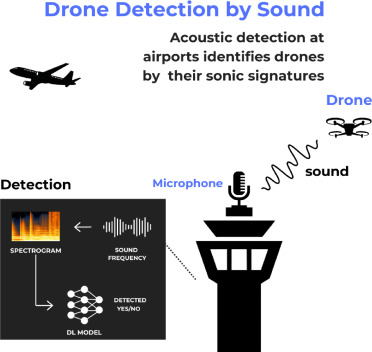
A microphone captures the drone’s sound waves, which are converted into a spectrogram. A deep learning model then classifies whether the sound originates from a drone. Advantages: low cost (~100–500 USD), passive operation, works in darkness. Limitations: short range 160–290 m in traffic noise, high sensitivity to airport noise, vulnerable to wind and weather.
Camera (computer vision)
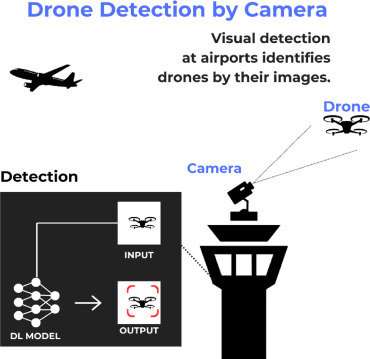
Cameras capture the airspace, a deep learning model (YOLO, ResNet and their newer variants) identifies the shapes and characteristics of drones. Advantages: high accuracy 75–98 % (mAP@0.5), speed 20–170 FPS, medium range 1–2 km. Limitations: dependence on lighting (day/night), weather conditions, requirement for a clear line of sight between sensor and drone.
RF detection
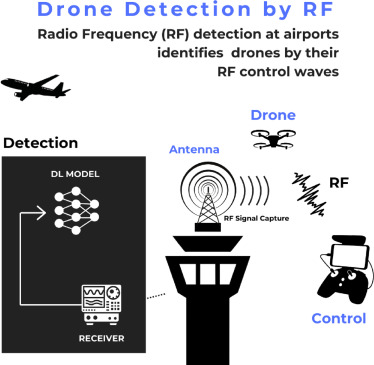
An antenna captures radio signals from the drone and its controller, a deep learning model distinguishes drone signals from other sources in the environment. Advantages: highest accuracy 90–99 % for known protocols, long range (>3 km), works without line of sight, in darkness and fog. Limitations: works only for known protocols, does not detect drones in quiet mode (no RF communication), a dense sensor network (>20 nodes) is needed for precise localisation at an airport.
Radar detection
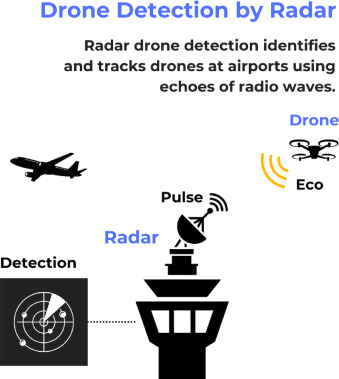
A radar emits radio pulses that reflect off the drone and return as an echo. Advantages: longest range 5–10+ km, works in all weather, direct 3D localisation. Limitations: high cost, >50 % false targets in real tests at Frankfurt and Munich airports, difficulty distinguishing a drone from a bird, interference in the electromagnetically saturated airport environment.
Multimodal fusion
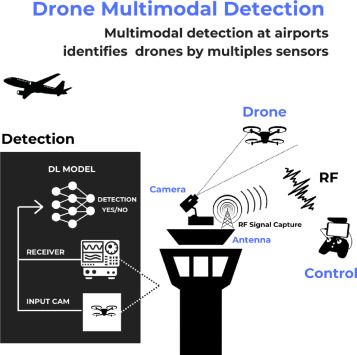
Fusion of multiple sensors (RF, acoustic, camera, radar) into one correlated picture. Advantages: highest accuracy (error <1.5 % of range), near-zero false alarms, redundancy — if one sensor fails, the others maintain the track. Limitations: high integration complexity, need for precise calibration and time synchronisation, higher processing latency.
Fusion implementation strategies
Technical literature distinguishes three basic approaches to sensor data fusion. They differ in the layer at which the combination is performed.
Early fusion
Combines raw data from different sensors before processing. It allows comprehensive analysis and theoretically the highest accuracy, but requires precise time and spatial synchronisation at the signal level. Demanding on transmission, storage and computational power.
Late fusion
Combines the outputs of individual sensors — that is, detection events or classification verdicts. Each sensor processes its data locally and sends only the result to the fusion layer. Simpler to integrate, less demanding on transmission, naturally respects the heterogeneity of sensors. This is the approach used by DroneEAR AI.
Hybrid fusion
Combines early and late fusion — for example, raw data is pre-processed locally and then fused at the event level with other sensors. The most complex solution, suitable for specific applications with high accuracy requirements.
Parameter comparison
Summary of typical parameters according to the review. Values vary significantly depending on the specific model, environment and drone characteristics.
| Technology | Accuracy | Range | Speed | Cost |
|---|---|---|---|---|
| Acoustic | 60–92 % (drops with noise and distance) | 160–290 m | Real-time, ~60 FPS | Low (~100–500 USD) |
| Camera (CV) | 75–98 % (mAP@0.5) | 1–2 km, exceptionally up to 5 km | 20–170 FPS | Low–medium |
| RF | 90–99 % (known protocols only) | >3 km | Real-time | Medium (SDR + antennas) |
| Radar | 80–92 % (PD), but >50 % false targets in real tests | 5–10+ km | 0.25–0.5 s / update | High (>100,000 USD) |
| Multimodal fusion | Highest — error <1.5 % of range | Depends on combination, typically up to 5 km | Higher latency (fusion) | Variable |
Source: Macedo, S. O., Caetano, M., & da Costa, R. M. (2025). Systematic review of drone detection at airports. Elsevier. Values are synthesised from the literature — real-world performance in an airport environment may differ significantly due to electromagnetic interference and clutter.
Key research gaps
The review identified three main gaps that DroneEAR AI directly addresses:
1. Lack of robust low-latency fusion algorithms
Most studies deal with individual sensors. True fusion — where one consistent track is created from multiple sources in real time — is still an open problem. DroneEAR AI is building exactly this layer: normalised events from heterogeneous sensors, deterministic correlation (Tier 1) and a local AI narrative (Tier 2).
2. Lack of public synchronised multimodal datasets
Without public, large and time-synchronised datasets it is not possible to compare models or train a new generation of fusion algorithms. DroneEAR AI therefore works with normalised events, not raw data — this allows training and measurement without having to publish sensitive audio or RF recordings.
3. "Function creep" risk and GDPR
Systems with cameras and RF sensors can indiscriminately capture data about the public. The review explicitly warns against a security tool becoming a mass surveillance tool. DroneEAR AI therefore processes only normalised detection events and runs on-premise, without storing raw audio or RF recordings.
Citation
Macedo, S. O., Caetano, M., & da Costa, R. M. (2025). Systematic review of drone detection at airports: benefits, limitations and future directions. Elsevier. The article is available on request.